
Daq IoT
The four-capabilities device for grid-connected distributed commercial and industrial PV

A new benchmark for intelligent control
1. Industry background: a mandatory requirement for distributed PV
As China’s dual-carbon strategy advances, installed commercial and industrial distributed PV capacity is growing explosively. But once large volumes of distributed generation connect to the grid, grid operating safety, power quality and dispatch response become pressing issues.
Since 2023, provincial grid companies have issued policies one after another requiring distributed PV projects connected at 380 V / 10 kV to provide the “four capabilities” — observable, controllable, adjustable and measurable.
| Capability | What it means | Value to the grid |
|---|---|---|
| Observable | Real-time monitoring of PV plant status and data | Visibility of resource distribution across the network |
| Controllable | Ability to execute remote commands such as switching and power limiting | Supports grid frequency stability |
| Adjustable | Flexible or firm regulation following dispatch instructions | Improves power quality |
| Measurable | Accurate acquisition and forecasting of generation output and other key indicators | Maintains node voltage stability |
Without the four capabilities, grid connection is not permitted. With them, the question becomes how to be compliant, economical and reliable at the same time.
2. The product: the Daq IoT PV four-capabilities control cabinet
Shanghai Daq IoT Technology Co., Ltd. (“Daq IoT”) has worked in energy IoT for many years. Responding to the grid-connection requirements for commercial and industrial distributed PV, the company offers an integrated, standardized, plug-and-play PV four-capabilities control cabinet.
2.1 Product photo
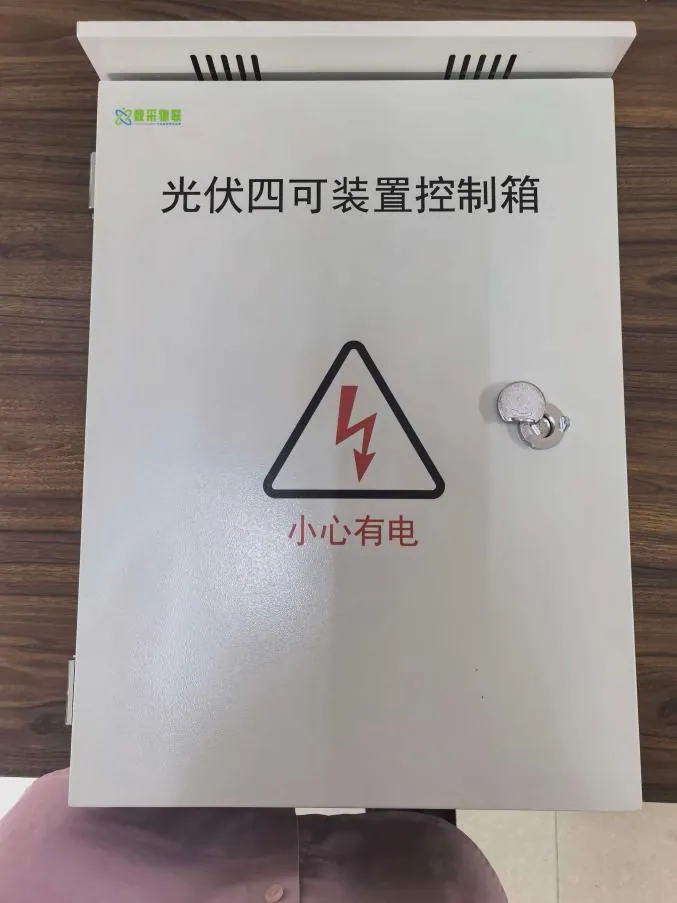
Figure 1 — PV four-capabilities control cabinet (exterior)
The enclosure is made of quality cold-rolled steel with a powder-coated finish and rated IP54 for harsh outdoor conditions. The front carries the Daq IoT brand and safety warnings and is fitted with a latch to keep the equipment secure.
2.2 Internal structure
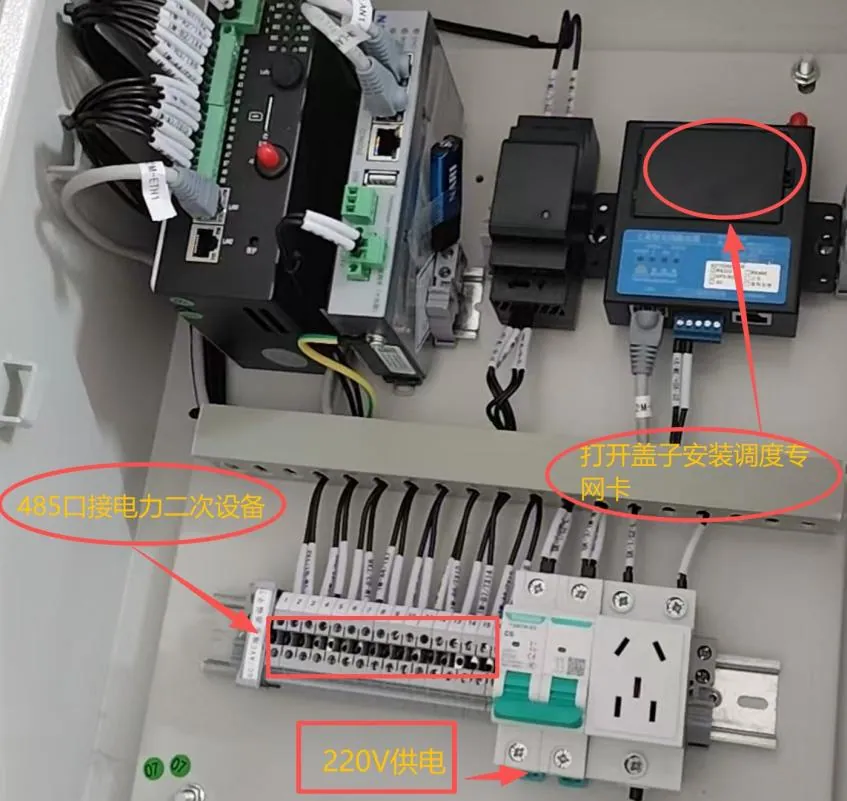
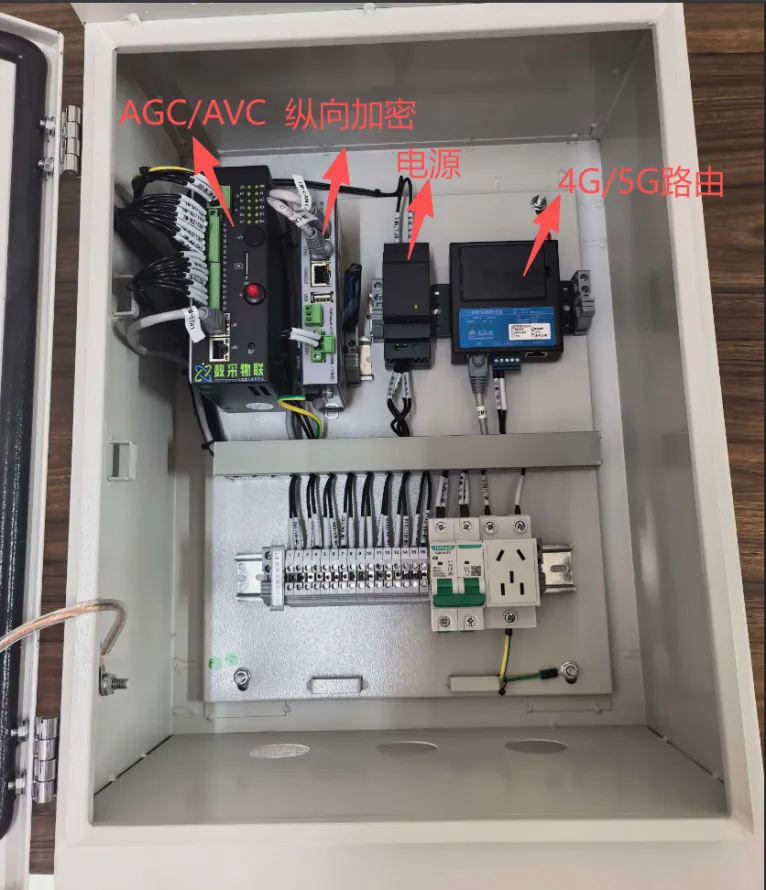
Figure 2 — Internal structure of the cabinet
The cabinet is highly integrated. Its core modules are:
| Module | Function |
|---|---|
| AGC/AVC server | Core control device of the grid dispatch automation system |
| Vertical encryption device | Certified under China’s commercial cryptography standards; meets the security protection requirements for power monitoring systems |
| Wireless communication module | 4G/5G, connecting to the dispatch master station |
| RS485 expansion port | Connects secondary equipment such as inverters and meters |
| Breaker + surge protection | 220 V supply and protection |
Wiring essentials: connect the 485 port to the power secondary equipment; open the cover to fit the dispatch private-network SIM; the 220 V supply must be stable and reliable.
2.3 System topology
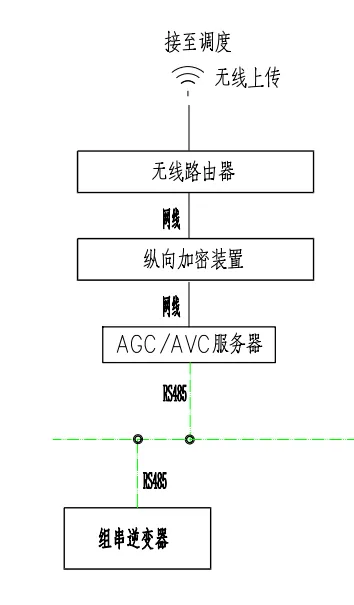
Figure 3 — Communication link topology
The complete communication chain: the string inverters connect over RS485 to the AGC/AVC server, which reaches the dispatch center through the vertical encryption device and the wireless router — from inverter to dispatch master station in a single cabinet.
3. Core advantages: why Daq IoT
1. Compliance that passes acceptance
Meets the requirements of the technical specification for distributed generation grid-connection performance; has passed the grid-connection testing of the provincial companies of State Grid and China Southern Power Grid; the vertical encryption module uses domestic cryptographic algorithms and satisfies Classified Protection of Cybersecurity 2.0 (MLPS 2.0).
2. Integrated design, easy to install
Pre-configured at the factory and ready to wire on arrival — no on-site programming; RS485, Ethernet and 4G all supported; a compact 360 × 500 × 260 mm footprint saves space in the distribution room.
3. Powerful AGC/AVC functions
Active power control accuracy ≤ 2% of rated capacity; power factor adjustment range ±0.8; response time < 30 s; supports IEC 104, Modbus and DL/T 645.
4. Remote O&M saves effort
Remote servicing and remote commissioning mean no engineer has to attend site, cutting labor cost.
5. Strong value for money
Compared with a discrete build (gateway + encryption device + panel), overall cost is more than 30% lower.
AGC/AVC key specifications:
| Item | Specification |
|---|---|
| Active power control accuracy | ≤ 2% of rated capacity |
| Power factor adjustment range | ±0.8 (leading / lagging) |
| Response time | < 30 s |
| Protocols supported | IEC 104 / Modbus / DL/T 645 |
4. Where it applies
| Site type | Typical application |
|---|---|
| Factory rooftop PV | County-wide rollout programs, green factory certification |
| Commercial complexes | Shopping malls, office buildings, warehousing and logistics parks |
| Agricultural PV | Fishery-solar and agriculture-solar complementary projects |
| Park microgrids | Generation-grid-load-storage integration projects |
Direct acquisition and direct control for 380 V / 10 kV distributed PV.
5. About Shanghai Daq IoT Technology Co., Ltd.
Shanghai Daq IoT Technology Co., Ltd. is a high-tech enterprise focused on energy digitalization, headquartered on the 16th floor, Building 6, Lane 888 Xinlang Road, Songjiang District, Shanghai.
Core business: energy IoT terminals, industrial data acquisition, intelligent sensors and grid-connection solutions for new energy
Technical strength: a portfolio of invention patents and software copyrights, with experience across hundreds of customers
Service network: delivery and support in more than 20 provinces across China
Typical customers: State Grid, China Southern Power Grid, the major state power generation groups and leading EPC contractors
6. Contact us
Company: Shanghai Daq IoT Technology Co., Ltd.
Address: 16F, Building 6, Lane 888 Xinlang Road, Songjiang District, Shanghai, China
Website:
Domestic sales: sale@daq-iot.com
Export sales: export@daq-iot.com
Tel: 400-9677-032