
Technical Proposal: Online Particle Counting and Cleanliness Monitoring System for the Laminating Cleanroom
Background and Requirements
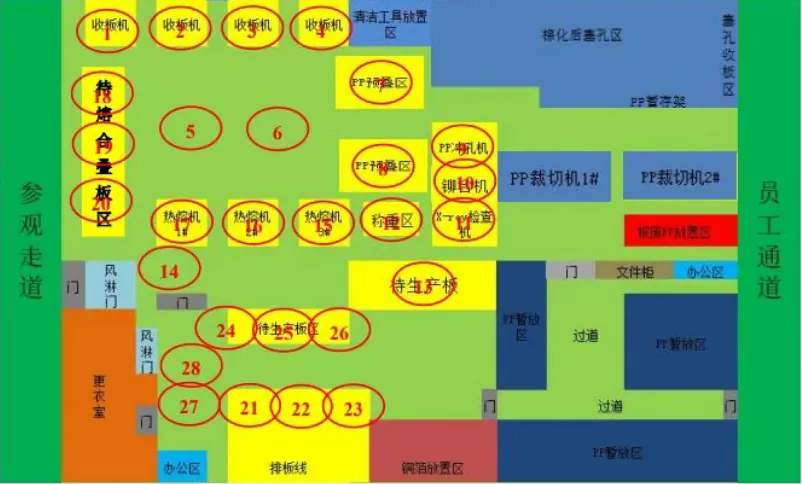
The laminating cleanroom has a total area of 1,072 m². Following the sampling-point count method in ISO 14644 A.4.1, 28 test points are required for test records.
Point selection rules:
Key areas: operating zones, within 1 m of equipment, pass boxes, entry and exit doors, material staging areas and similar
Non-key areas: beyond 1 m from equipment, open floor areas and similar.
Point requirements: sampling points sit 1 m to 1.5 m above the floor. The distribution of particle-count points across the cleanroom area is as follows:
Requirement: data acquisition over the internal network.
The products below match these requirements and form the implementation plan. They acquire cleanroom air parameters effectively and in real time, which makes production environment management easier. Acquisition is implemented by adding acquisition devices; wired or wireless transmission carries the cleanroom air data to a data platform or into a database.
Matching Acquisition Product
The matching product is our DAQ-GP-CLXX series cleanliness monitor terminal (model chosen according to the networking method): the DAQ-GP-CLXX cleanliness monitor. Key parameters and functions:
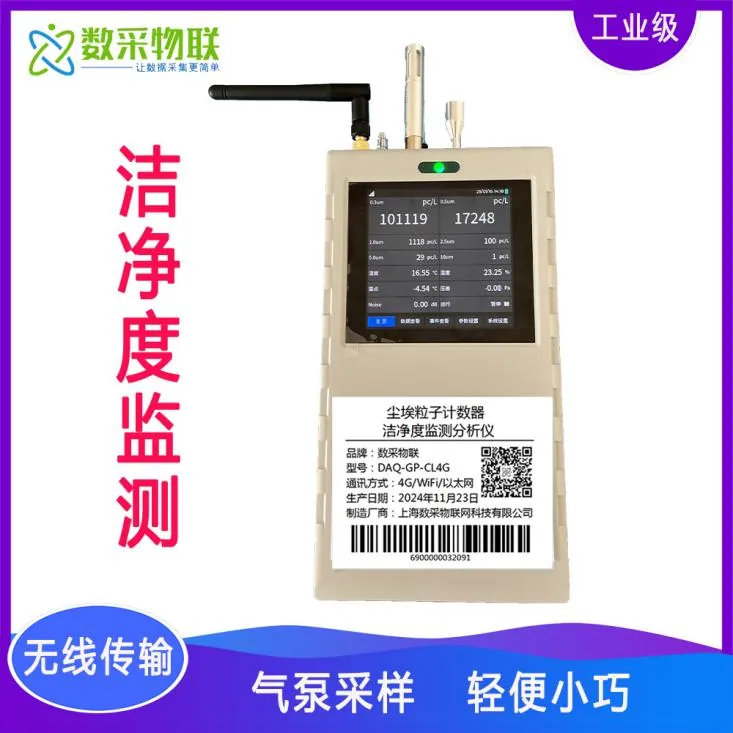
Acquisition Characteristics
Particle detection range: 0.3–10 μm
Particle resolution: 1 μg/m³
Particle range: 0–200000 particles/L
Pressure range: ±500 Pa
Pressure error: 0–1%
Temperature error: ±0.5 °C
Flow rate error: ±5% @ 2.83 L
Electrical Characteristics
Power supply: 12 V DC (DC 5.5×2.1 mm female jack)
Charging: 5 V DC (USB Type-C)
Battery capacity: 2000 mAh
Operating current: 550 mA
Standby current: 200 mA
Communication
Transmission: 4G (default) / RJ45 / Wi-Fi
Protocols: MQTT / TCP; other protocols on request
Data forwarding: any public server
Heartbeat: customizable heartbeat packet
Registration packet: customizable; can be set to the IMEI
Mechanical
Antenna: external rod antenna
Display: 480×480 color LCD (capacitive touchscreen)
Material: ABS plastic housing
Weight: 800 g
Dimensions: 215×114×48 mm
Mounting: adhesive or screw fixing
Operating Environment
Temperature: −10 °C to 60 °C
Humidity: 0–95% RH
Acquisition Method, Installation Advantages and Site Considerations
3.1 Technical Approach
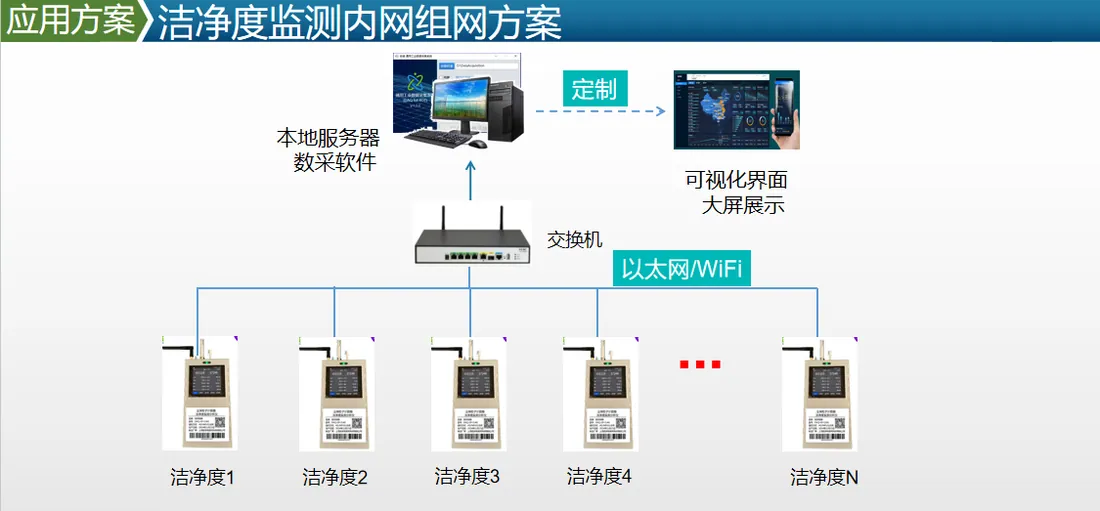
Technical approach topology
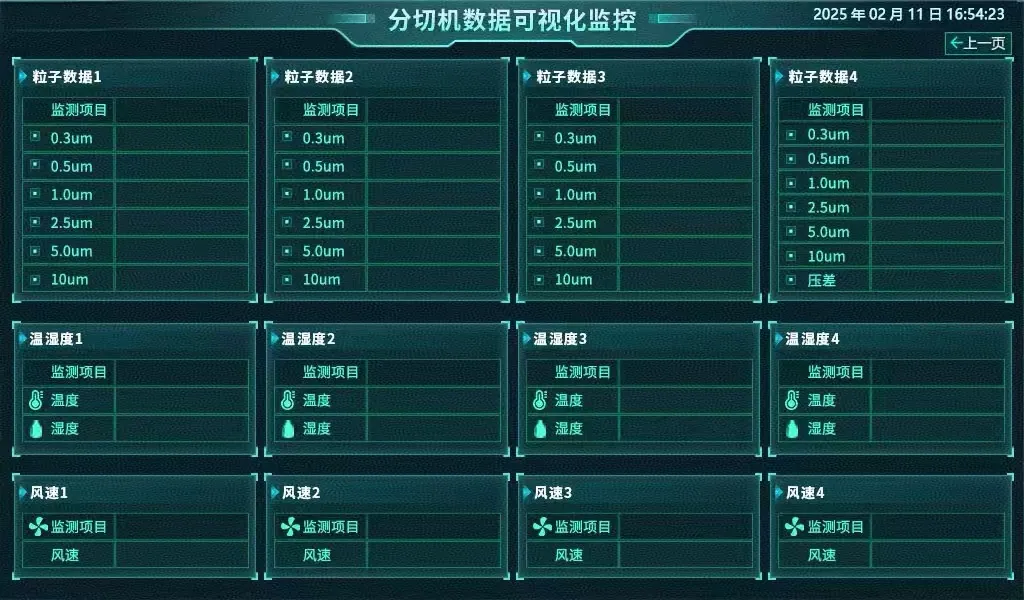
The 28 monitoring points in the laminating cleanroom are monitored for particle count over the internal network. Points connect by intranet cable or Wi-Fi, and the host system runs the acquisition software that receives and parses cleanliness data from each point. Collected data can be stored in a database or passed to a third-party platform, and secondary development on that data (large-screen display and similar) is supported.
Example of the large-screen display
3.2 Installation Advantages
Wireless transmission supported; installation is simple.
Built-in lithium battery supports both handheld and online monitoring.
Connects to any IoT cloud platform, MES and other third-party software through a documented data protocol.
Out-of-limit alarm, compliant with ISO 14644-1 and GB/T 16292-1996.
Historical data query.
3.3 Installation Considerations
-
Online real-time monitoring depends on site power conditions; a 220 V AC to 12 V DC adapter is supplied.
-
The fixing method on site must be decided.
-
Do not open the housing; servicing is for qualified personnel only.
-
Do not expose the product to direct sunlight or other heat sources, and do not store it outdoors.
-
The ABS flame-retardant engineering plastic housing resists attack by acids, alkalis and similar chemicals.
-
Do not use the product in extreme environments.
Construction Safety Measures (Optional)
-
Check tools before use and replace any that are defective.
-
Assign a supervisor for the work, responsible for quality and safety across the whole operation.
-
Provide operating personnel with the necessary PPE: work clothing, shoes, gloves, helmet and similar.
-
For work involving electricity, isolate and test for dead before the next step.
-
Tag and lock the breaker or switch with “Work in progress — do not switch on”, and apply a ground on the busbar side.
-
Erect barriers around the work area to prevent access to the wrong compartment.
-
Start work only after all safety measures are in place.
-
During simultaneous operations, never work on two levels of the same face at once. Observe the “three no-harm” rule, correct habitual operating errors and schedule installation work to avoid clashes.
-
On completion, carry out insulation checks and clear the site: remove all waste, debris and temporary tools that are no longer needed, so that the work is finished, the material is cleared and the area is clean.
-
Do not work while fatigued; rotate staff who are not fit for the task. Never enter a well after drinking or when unwell.
-
Self-inspect on completion, then have the client’s responsible person check and confirm. Energize and commission only after confirmation.
After-Sales Service
Our commitment: to keep after-sales quality consistent, our service procedures and after-sales rules require service staff to work warmly, sincerely, patiently and thoroughly for the customer. Routine support: a contact person is assigned the same day a call comes in and works the issue through to resolution. Urgent or special support: response within 2 hours of the call on the same day, so the product keeps working normally.