
Suggested Titles (AI)
Pain-Point Questions
Wells spread over a wide area and hard to inspect? This monitoring solution takes care of it.
Still checking wells by hand? Idling and fault shutdowns go undetected.
High pumping energy and chaotic scheduling? Well monitoring gives you the data.
Electrical faults at the well handled too slowly, and irrigation falls behind — what do you do?
Dozens of wells watched by dedicated staff, labor cost stays high? Try unattended operation.
Old wells with no meters — where do you start with energy accounting and water-saving upgrades?
Benefit and Value
With well monitoring live, O&M cost drops 60% and management efficiency rises 80%.
Smart wells on the farm: water and energy saved, less effort, higher irrigation efficiency.
Data-driven irrigation scheduling puts every kilowatt-hour where it matters.
Upgraded electrical protection for wells rules out equipment damage and safety incidents.
A 30-minute installation per point brings fine-grained well management at low cost.
One solution covers well monitoring and lays the data foundation for smart agriculture.
Scenario Solutions
A complete solution for intelligent monitoring of farmland irrigation well operation — easy to deploy, highly reliable.
Wells scattered across a wide area? A wireless, non-invasive monitoring solution.
Old wells without meters? Precise data acquisition that fits them.
Distributed irrigation loads on the farm: one-stop energy and status monitoring.
Township and village-owned wells: a dedicated remote centralized management solution.
Solution Background
Farmland irrigation wells are core agricultural infrastructure, yet they are widely scattered, hard to cable in the field, expensive to inspect manually and slow to supervise. Manual rounds cannot cover all hours, and electrical faults or abnormal shutdowns delay irrigation; energy use is hard to measure accurately and scheduling is hard to optimize. Built around the SC-GP-EM4G wireless power monitor and related products from Shanghai Daq IoT Technology Co., Ltd., this solution forms a low-cost, easy-to-deploy and highly reliable monitoring system for irrigation wells. It collects electrical parameters in real time, monitors operating status remotely and raises automatic alarms on exceptions, moving irrigation from manual management to intelligent, fine-grained management and giving agriculture the data and technical basis it needs to save water and energy and irrigate more efficiently.
Core Objectives
1. Full-parameter real-time monitoring: the system collects single-phase and three-phase voltage, current, active power, apparent power, power factor and active energy from the well pump, so the electrical load and power use of each well are visible as they happen.
2. Intelligent status assessment: changes in power data are used to determine automatically whether a well is starting, stopping, running normally, shut down by fault or running unloaded, which rules out idling and abnormal shutdown.
3. Automatic exception alarms: overvoltage, overcurrent, device offline and loss of voltage trigger immediate alarms pushed through the platform and by SMS, protecting well electrics and shortening fault handling.
4. Energy data analysis: historical operating and energy data is stored automatically and can be reported by hour, day or month as tables and trend curves, giving a data basis for irrigation scheduling, energy quotas and water and energy saving.
5. Unattended centralized management: the system replaces manual rounds with remote centralized monitoring of many wells at once, so a single manager can look after dozens of wells and labor and material costs fall sharply.
6. Flexible integration: the system connects to third-party agricultural IoT platforms and smart farming management systems, shares data and fits an overall smart agriculture rollout.
Core Monitoring Device and Specifications
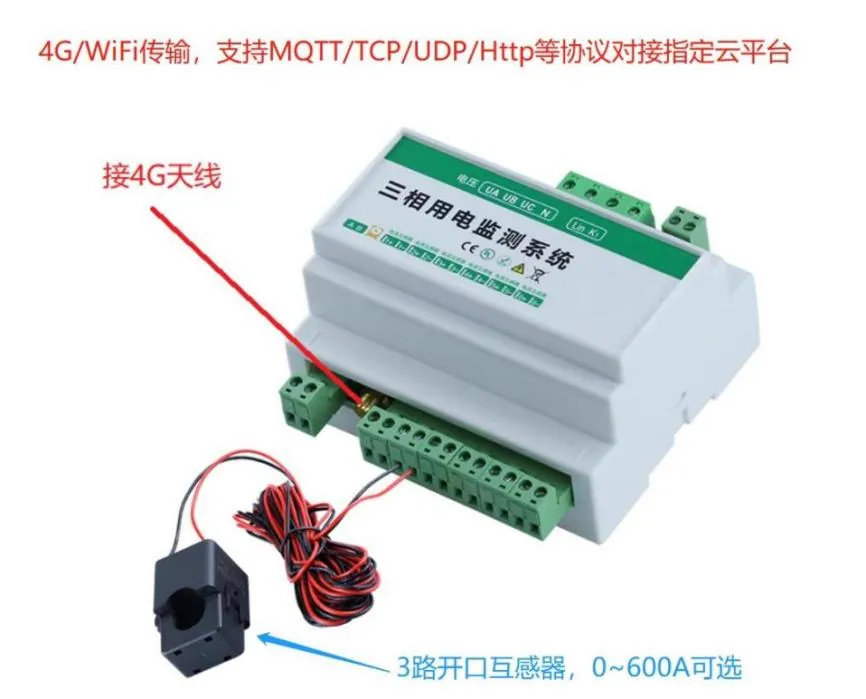
The SC-GP-EM4G wireless power monitor from Daq IoT is designed for distributed industrial equipment and suited to the outdoor conditions of farmland. It needs no complex on-site cabling and can be added to a well distribution box quickly, which makes it the practical choice for distributed well monitoring.
2.1 Core Functions
-
Supports single-phase and three-phase well equipment. It collects voltage and current in real time and calculates active power, apparent power, power factor, operating frequency and active energy, reproducing the electrical behavior of the well completely.
-
Data can be transmitted over 4G, WiFi or LoRa and uploaded directly to the cloud platform for remote viewing in real time.
-
With a relay it cuts power automatically on overvoltage or overcurrent, protecting the well electrics from damage caused by electrical faults.
-
The default reporting interval is 5 minutes, and the interval can be changed remotely to suit different irrigation scenarios.
2.2 Key Hardware Parameters
-
Enclosure: ABS flame-retardant material, rated for the outdoor conditions of farmland at −20 °C to 70 °C and 0–95% RH without condensation, dust-tight and resistant to aging.
-
Mounting: wall-mounted, compact and light (200 g), fitting directly inside the well distribution box and saving space.
-
Acquisition channels: 6 AC current and voltage channels; current transformers available in 0–600 A ranges (100 A by default), matching pumps of different ratings.
-
Measurement accuracy: voltage 100 V–400 V (0.5% rdg.), current 0–100 A (2% rdg.), accurate enough for agricultural metering.
-
Power supply: 220 V AC; the RS-485 line is protected against 4000 V surges and electrostatic discharge, keeping the device stable in service.
2.3 Core Advantages
-
Non-invasive acquisition: split-core current transformers clamp onto the well circuit without disconnecting any wiring, so the well keeps working during installation.
-
Easy installation: an electrician only has to connect power on site, with no specialist commissioning, and a single point takes little time, so many wells can be deployed in batches quickly.
-
Protocol compatibility: Modbus RTU, MQTT, TCP, UDP and HTTP are supported, allowing direct connection to the platform; custom protocols are available.
-
Platform included: the device connects to the Daq IoT industrial IoT platform by default, with both desktop and mobile interfaces, so no separate platform development is needed — it works out of the box.
2.4 Auxiliary Devices
IoT gateway: where 4G coverage in the field is weak, a LoRa gateway aggregates data and keeps the uplink stable.
Extension antenna: for wells with weak 4G signal, an external antenna runs to a spot outside the distribution box where reception is good, removing the blind spot.
Relay: works with the wireless power monitor to cut power automatically on overvoltage or overcurrent, raising the level of electrical protection at the well.
System Architecture
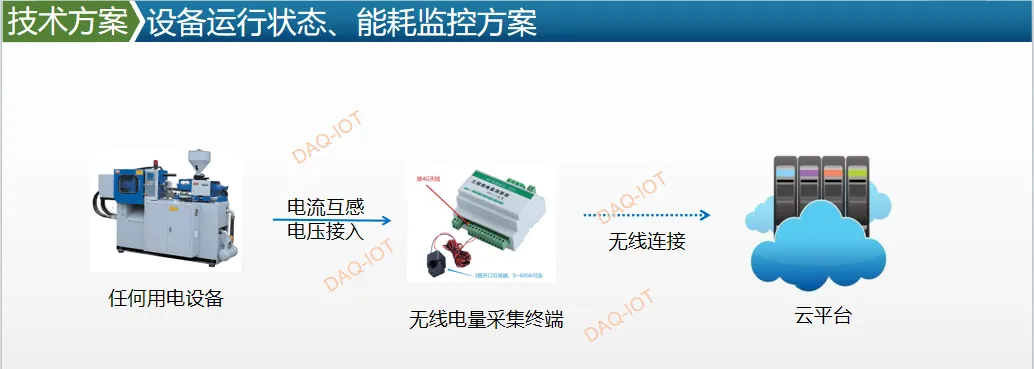
The solution uses a four-layer architecture — perception, transmission, platform and application — to cover the whole monitoring workflow. The design fits the wide distribution, cabling difficulty and harsh environment of farmland.
(1) Perception layer: the data acquisition core
This layer consists of the SC-GP-EM4G wireless power monitors installed in each well distribution box. They collect voltage, current, power and energy, providing the data foundation for the whole system. All perception-layer devices are wireless and non-invasive, so deployment is fast and involves no construction work.
(2) Transmission layer: wireless data exchange
Transmission is primarily 4G, backed by LoRa and NB-IoT. Data from the perception layer goes straight to the cloud platform over 4G; where 4G coverage is missing in the field, a LoRa gateway aggregates the data before upload. Every well keeps a continuous data link with no field cabling, which keeps construction cost down.
(3) Platform layer: the data processing hub
The Daq IoT industrial IoT platform (which also connects to third-party platforms) receives, stores, analyzes, alarms on and summarizes the data. It refreshes data in real time and provides historical storage, curve generation, report export and alarm configuration, giving the application layer both data and management capability.
(4) Application layer: remote management terminals
A browser interface for desktop and a WeChat interface for mobile give managers access from the office or from the field. They can view live data, operating status and historical reports at any time and receive exception alarms, so wells are managed centrally and remotely — genuinely unattended, with control in hand.
On-Site Installation and Deployment
Installation follows the principles of safety, convenience and speed. All wiring is carried out by qualified electricians in line with farmland electrical safety rules, and a single point can be installed within 30 minutes.
(1) Preliminary Site Survey and Preparation
-
Well parameters: record the single-phase or three-phase type, rating and cable gauge of each pump, and match the CT bore (16 mm or 24 mm) and range (0–100 A or 0–600 A) accordingly.
-
Installation position: identify space in the distribution box for the monitor and CTs, preferably at the main pump breaker, and leave room to work.
-
Signal test: measure 4G strength at each well, paying attention to remote field locations and tightly sealed boxes, and prepare extension antennas and LoRa gateways in advance.
-
Power planning: confirm the supply available in the box, plan a feed for the monitor and provide isolation for the power source.
(2) On-Site Installation Steps
-
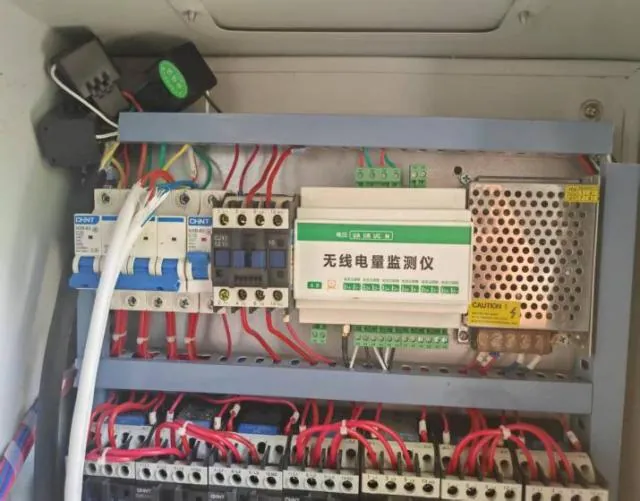
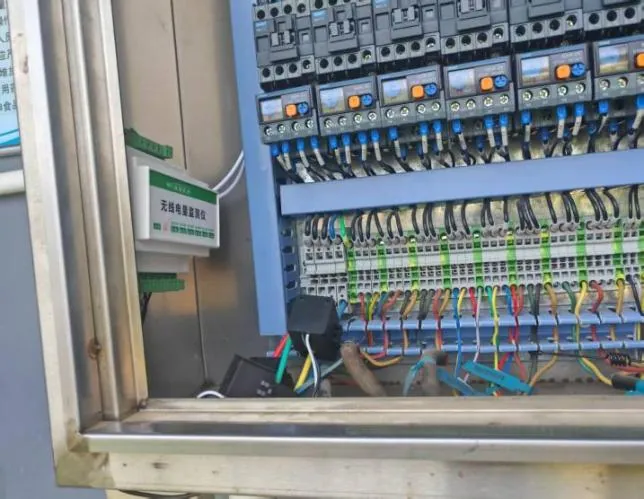
CT installation: clamp the split-core CTs directly onto the three-phase or single-phase well circuit without disconnecting wiring, then secure them so contact with the conductor is reliable.
-
Monitor mounting and wiring: fix the SC-GP-EM4G on the wall inside the box in a dry, vibration-free position, connect the CT leads to the current terminals and wire the site circuits to the voltage terminals. Insulate every connection to prevent short circuits.
-
Antenna: connect the 4G antenna to the monitor. Where signal is weak, run an extension cable to a position outside the box with good reception, and seal the cable entry against dust and moisture.
-
Power-up: connect the monitor’s DC supply, check all wiring and then switch on, confirming from the indicator lights that the device starts normally.
-
Minimal monitoring points: for low-power wells, fit only a wireless current sensor, clipped onto the conductor. Once switched on it collects current data, and a battery-powered sensor needs no external supply.
(3) Remote Configuration and Platform Commissioning
-
Remote parameter setup: technicians configure acquisition interval, transmission protocol and platform address remotely, with no on-site commissioning.
-
Platform connection test: the device is connected to the Daq IoT platform and data transmission is verified, confirming that voltage, current and power reach both the desktop and mobile interfaces without delay.
-
Alarm rules: thresholds for overvoltage, overcurrent, device offline and zero current are configured on the platform according to well operating requirements, along with the notification channel (email, SMS and so on).
-
Third-party integration: where a smart farming or irrigation scheduling platform is involved, the data format is adapted to its protocol so reporting and synchronization run automatically without manual work.
(4) Key Installation Precautions
-
All wiring must be done with the power off. Live work is not permitted.
-
CT bore and range must match the site circuit exactly; a mismatch introduces measurement error.
-
After installation, run the system for 24 hours to check data transmission, acquisition accuracy and alarm triggering, and adjust as needed.
-
Outdoor distribution boxes must be protected against water, dust and rodents so the monitoring equipment is not damaged by the environment.
-
Give each well device a unique ID and a device name so points can be located precisely and managed centrally later.
Core Platform Functions
The Daq IoT platform supplied with the solution covers the full monitoring workflow. Both the desktop and mobile interfaces are clear and simple, needing no specialist training.
(1) Real-Time Data Monitoring
The platform displays voltage, current, active power, apparent power, power factor and active energy for every well, refreshed in real time. Each well carries a unique ID and point name, so managers can locate a single well quickly and see its status without going to site.
(2) Intelligent Status Assessment
Changes in power data determine the well’s condition automatically:
Current and power present and stable: the well is running normally.
No current or power but the device online: the well is stopped.
Device online, current at zero, voltage normal: the pump is running dry or has shut down on fault.
Current and power fluctuating abnormally: the load is abnormal. Every status is labeled in real time so managers spot abnormal conditions quickly.
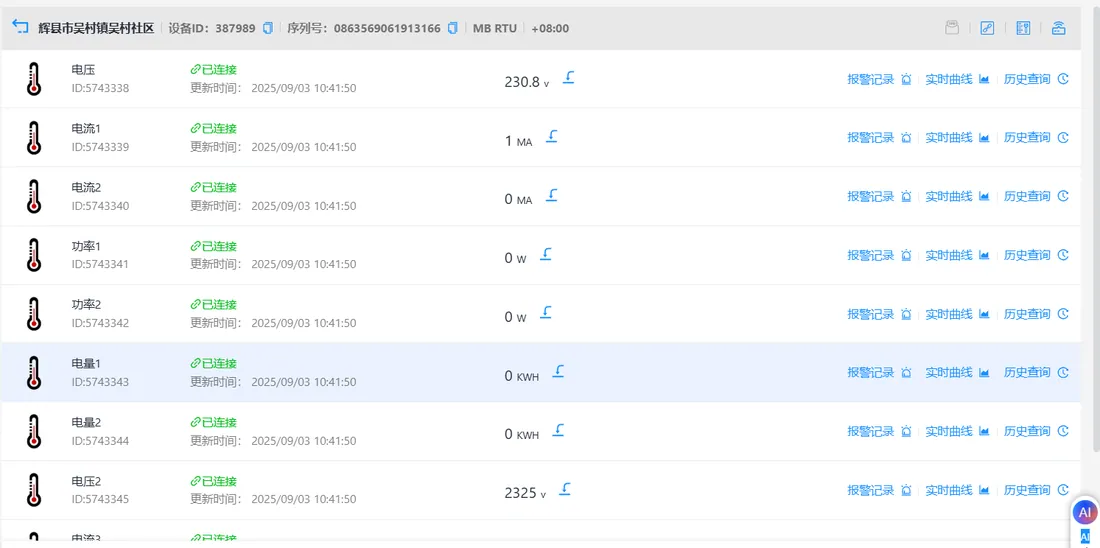
(3) Automatic Exception Alarms
When a well shows overvoltage, overcurrent, loss of voltage, device offline or unloaded running, the platform raises an alarm at once and pushes it by email or SMS. The message carries the well ID, point and time of occurrence, so staff can respond immediately, limit the impact on irrigation and prevent damage from electrical faults.
(4) Historical Data Management and Analysis
The platform stores operating and energy data for every well with no time limit. Data can be queried by hour, day, month or a custom range, plotted as live curves and energy trends, and summarized automatically with maximum, minimum and average values of voltage, current and power for each period. Reports export to Excel, giving accurate input for irrigation scheduling, energy analysis and equipment maintenance.
(5) Multi-Point Centralized Management
Wells can be added in batches and grouped by township, village or field block. Managers see the online and operating status of all wells on one screen, so dozens or even hundreds of wells are monitored centrally by one person, which raises management efficiency considerably.
(6) Remote Device Management
Device parameters such as acquisition interval and alarm thresholds can be changed remotely without a site visit. Online and communication status can be checked remotely to catch offline devices early, and firmware can be upgraded over the air so device functions keep improving.
(7) Seamless Third-Party Integration
Collected data can be passed over standard protocols such as MQTT, TCP, UDP and HTTP to third-party agricultural IoT platforms, smart farming management systems and irrigation scheduling systems. Data is shared without dedicated interface development, which fits local smart agriculture plans and lowers integration cost.
Core Advantages
Built on Daq IoT products and matched to real well conditions, the solution offers six advantages over manual management and other monitoring approaches:
-
Easy to deploy, fast to roll out: wireless and non-invasive, with split-core CTs that simply clamp on. There is no field cabling, a point takes 30 minutes and ordinary workers can do it, so many wells can be deployed quickly across a wide area.
-
Low cost, low maintenance: compared with wired monitoring, most cabling and construction cost disappears, and devices need no dedicated on-site maintenance — remote inspection is enough.
-
High reliability, wide fit: the ABS flame-retardant enclosure with reverse-polarity, surge and electrostatic protection suits harsh outdoor conditions; 4G, LoRa and NB-IoT options remove network blind spots; and single-phase and three-phase wells of any rating are supported, including old wells with no meter.
-
Intelligent and unattended: data is collected, uploaded and analyzed automatically, status is assessed automatically and exceptions raise their own alarms, replacing manual rounds with 24/7 unattended centralized management.
-
Complete data for decisions: full electrical parameters are collected and history is stored automatically, producing reports and trend curves that support irrigation scheduling, energy quotas, water and energy saving upgrades and equipment maintenance.
-
Strong service: Daq IoT provides free remote guidance, remote configuration and commissioning, and free IoT consulting. On-site installation needs no specialist commissioning, and 7×24 technical support keeps the system running over the long term.
Implementation Plan and Schedule
Implementation follows five steps — preparation, on-site installation, platform commissioning, trial run and go-live — and the overall schedule flexes with the number of wells. Several dozen wells in one village or block can be completed in 3–7 days.
-
Preparation (1–2 days): site survey, device selection and stocking, staffing and a confirmed installation plan.
-
On-site installation (by point count): qualified electrician teams work in groups, 30 minutes per point, completing 20–30 wells a day.
-
Platform commissioning (0.5–1 day): remote device configuration, platform connection and alarm rules, with data transmission and functions tested.
-
Trial run (1–2 days): all devices run online while data acquisition, alarm triggering and platform operation are checked and fine-tuned.
-
Go-live (0.5 day): managers are trained on the platform, the solution enters service and moves into routine operation.
Operation, Maintenance and Technical Service
To keep the well monitoring system running reliably over the long term, Shanghai Daq IoT Technology Co., Ltd. provides full after-sales maintenance and technical service, along with simple on-site maintenance rules.
(1) Platform Services
-
The platform runs continuously, 24/7, with a dedicated team maintaining servers and network so data storage and transmission stay secure.
-
Platform features and upgrades are provided free of charge, with data display, reporting and alarming refined to user requirements.
-
7×24 remote technical support responds promptly to platform operation and data issues and resolves them quickly.
(2) Device Services
-
Devices carry the manufacturer’s warranty, with free repair or replacement of faulty units during the warranty period.
-
Technicians inspect device status remotely at intervals, checking online rates and data transmission and resolving offline devices and data anomalies promptly.
-
Every six months an on-site inspection is guided, covering wiring, CTs and antenna mounting and cleaning dust from device surfaces.
(3) Simple On-Site Maintenance Rules
-
Farm managers should check well distribution boxes periodically and keep them proof against water, dust and rodents so the equipment is not damaged by the environment.
-
If a device goes offline, first check the supply to the box and whether the antenna has come loose. Simple faults can be handled on site; complex ones should go to the technical team.
-
After the irrigation season, give the equipment a full check, isolate its power and protect it so it is ready for the following year.
(4) Training
Before go-live, farm managers receive free platform training covering live data, historical queries, alarm handling and device grouping. Training combines demonstration with hands-on practice so managers become productive quickly.
Benefit Analysis
The solution removes the pain points of traditional well management and delivers clear economic, efficiency, safety and management benefits.
(1) Economic: Water and Energy Saved, Cost Reduced
-
Accurate energy statistics allow irrigation scheduling to be optimized, avoiding idling and over-irrigation, which saves water and energy and cuts pumping cost.
-
Manual rounds are replaced, removing most of the labor, material and time spent on inspection. Field cases show management efficiency up more than 80% and O&M cost down more than 60%.
(2) Efficiency: Precise Scheduling, Better Irrigation
-
Well status is monitored in real time, so faults are found and fixed quickly and irrigation is not delayed by a stopped well.
-
Analysis of well operating data gives a sound basis for scheduling, enabling irrigation on demand and with precision, which raises overall irrigation efficiency.
(3) Safety: Intelligent Protection for Electrical Safety
-
Electrical parameters are monitored continuously, with automatic alarms and interlocked power cut-off on overvoltage and overcurrent, so equipment is not damaged by electrical faults and repair cost falls.
-
Well power monitoring is standardized, electrical hazards are found early and farm production safety incidents are prevented.
(4) Management: Data-Driven, Fine-Grained Control
-
Management shifts from experience to data: all well operating data can be queried, analyzed and traced, giving accurate support for irrigation decisions.
-
Wells are managed centrally and remotely, raising the standard of infrastructure management and laying a data foundation for the smart agriculture that follows.
Extended Applications
Beyond irrigation wells, the solution applies to farm pump stations, booster equipment on irrigation networks, greenhouse water supply and small rural water facilities — any distributed agricultural load that needs energy accounting and status monitoring. The same approach carries over to distributed equipment monitoring in industrial parks, factories and pollution control, providing a practical, repeatable wireless data acquisition model for intelligent facility management.
Shanghai Daq IoT Technology Co., Ltd. works on the principle of making data acquisition simpler. It supports customers from device selection and solution design through on-site installation to after-sales service, with free technical consulting and remote guidance throughout, helping irrigation move toward intelligent operation and smart agriculture.